
Hyundai has been gathering much momentum and attention over the last decade. These innovative Koreans have been busy indeed, pushing to expand in the road car performance segment (Hyundai N), the luxury segment (Genesis) and even in motorsport with their own LMH entry under Genesis Magma Racing. As Korean food goes, things are getting extra spicy.

The brand’s sex appeal has no doubt improved immensely thanks to regular cameos and even branded appearances in many popular K-Dramas which have helped change public perception, from staid to sexy.

Hyundai N in particular is now becoming serious with its performance offerings. Established in 2012, the N moniker purportedly stands for two things: the first is a reference to the Namyang District in Seoul, South Korea which is home to Hyundai’s Global R&D Center.

The second is a nod to the infamous 20-km Nordschleife or Northern Loop of the Nurburgring Circuit in Germany’s Eiffel Region. Hyundai N opened an R&D / motorsports facility for testing their cars at the famed Green Hell, another apt nickname for the world’s toughest circuit. The Nurburgring is the place to hone your engineering chops, your chassis dynamics, engine, suspension and the cohesive overall performance if you want to earn universal respect. In 2013 they had even hired former BMW M Chief Engineer Albert Biermann as Executive Vice President and Head of Vehicle Testing and High-Performance Development. They were very serious as early as then to develop and build fast, exciting cars.

It would take a few more years before Hyundai would unveil its first road car, the i30 N in 2017. Today, Hyundai has three current N models, with plans for seven in total by 2030. Hyundai even has N-Line models which are the regular spice level models of the standard vehicle line-up: more power than standard, elevated performance and an aggressive bodykit identify these models. But they still fall below the full-on N models’ performance.

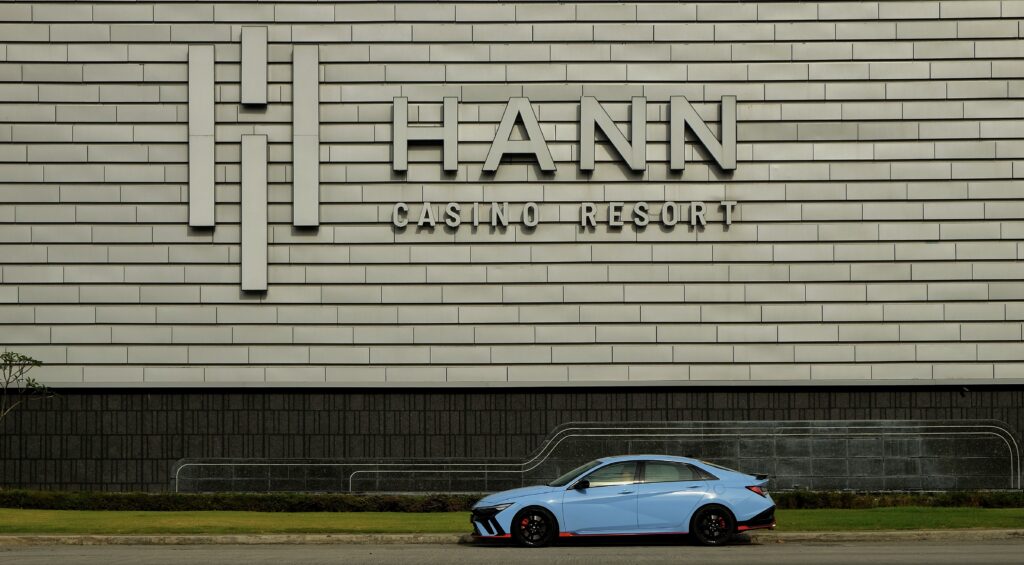
Today, I have the keys to the Elantra N. It’s a big car, with long overhangs which make it feel even bigger, going up against rivals like the recently discontinued FL5 Civic Type-R (but with units still floating around Honda dealerships apparently), the recently introduced GR Corolla plus the turbocharged and symmetrical all-wheel drive Impreza sedan and wagon, all performance variants of their regular models.

Upon first glance, the Elantra N looks a tad awkward: the front looks sharp, futuristic and mecha-like.

But the rear has these odd lines and an equally awkward rear valance. Perhaps the development team were stuck with the base vehicle’s lines. Or went straight to soju and makgeolli. But these soulful drinks are perhaps what gave birth to Hyundai N in the first place too.

Inside, the huge dual 10.25 inch LCD displays grabs your attention.

There’s wired Apple CarPlay / Android Auto available, plus a Hyundai N mode on the screen that displays a variety of vehicle and engine parameters. Think on-board live data telemetry inspired by motorsport, plus adjustments for the engine, transmission, e-lsd, steering and stability control.

Plush, supportive and comfortable leather seats, perforated to keep your bum and back cool, keep you in place

A very sporty and futuristic 3-spoke steering wheel with paddle shifters plus auxiliary buttons for the multi-media system reaches out to your hands.

And there are also three Hyundai N exclusive buttons.

The powertrain is Hyundai’s 2.0 liter gasoline engine called the Theta II. It produces 276hp and 400 Newton-Meters of torque driving the front wheels via a 8-speed wet type dual-clutch automatic transmission.

The Elantra N benefits also from an electronically controlled limited slip differential and perhaps most significantly, a multi-link rear suspension in lieu of the standard Elantra’s rudimentary torsion-beam rear setup which truly elevates the Elantra’s handling from clumsy to classy.

As an experience, the Hyundai Elantra N is a valiant early effort from Hyundai’s N division. The cynic will say they have been around for well over a decade, but brilliance takes time, and a few generations. And it was worth the wait. The Elantra is fast, it’s pretty engaging, it stops very well and it tells you what’s going on. It’s also very unique, not just another look-at-me I’m fast sort of deal. It has character, a real identity in both its looks and the driving feel.

The steering, initially a tad numb, is decently weighted and offers great feedback while filtering out road much of the road’s harshness. It gets better as speeds pile up, the grippy 19-inch Michelin Pilot Sport 4S tires sized 245/35R19 offering very good information of the road that effectively transmits to the steering wheel.

As a highway cruiser, the Elantra is in its element: it gobbles up the miles, has the potential to do an easy ~10.5km/liter despite packing serious power. The 8-speed DCT is responsive as is the engine itself which makes a very decent turbine-like whoosh at full-tilt, coupled with an aggressive growl form the exhaust. It has a surprisingly thick mid-range followed by a decent top-end lunge.

The strong mid-range makes it a relaxed high-speed cruiser that can quickly transition to a v-max missile. On fast and flowing A-roads, with gentle undulations and flowing sweepers, the Elantra N shines.

It feels properly fast and flows beautifully, giving the entire car just enough of a lively exercise to stretch the kinks out of its body. On these roads, most regular Hyundais would be left breathless, well outside of their environment. The Elantra N craves these conditions, looking for extra excitement.

The one caveat: its e-LSD doesn’t do as good a job at quelling the considerable torque-steer you get when you hammer it through the twisty bits. Thankfully, despite the sport-tuned suspension, ride is still pliant and the sporty seats hold you in place comfortably as well. I just wish it had a bit more thigh and hip bolsters to help keep you in place.

On tight, ribbon-like b-roads roads, the Elantra N rolls considerably; despite the firm suspension, the chassis sways and leans heavily on its sides. It needs stiffer anti-roll bars to help control chassis movement and bring back some precious precision to the equation.

On corner exit, the Elantra N feels a bit wayward too; you need more rear camber and a smidge more of stabilizing toe-in to keep it under control on the faster bits.

But it’s also the same roll which teaches you to be smoother, anticipate, feed in the throttle slowly, wind / unwind steering lock carefully and relish the chassis communicating with you. After more than a week with the Elantra N, I genuinely enjoyed each drive, plus the attention it got was surprising. No doubt the color is unique, more so the rate it suddenly accelerates like a scalded cat when you floor the throttle.

Thankfully, many of its minor shortcomings can be alleviated by the aftermarket: stainless steel brake lines with better fluid for improved feel, followed by more aggressive brake pads. Aftermarket coilovers to help you corner-weight and really dial-in the car. Some form of camber / caster adjustability, and eventually, more power which should be a cinch given the engine’s turbocharged prowess.

The Elantra N is a bit of a wild child: it needs a bit more more polish, a tad more experience and a more cohesive design (again, that ungainly rear end) to really stand out and become a true driver’s car that will age gracefully. But truthfully, it’s also these minor foibles that help give the Elantra its character, its charm. It’s so close to being really really really good. Hopefully, Hyundai N really nails the next generation of N cars perfectly.

Like proper kimchi-jiggae, it’s an acquired taste, an assault to the senses. But you will never find anything as explosive, as exquisite and as delectable as Korea’s spicy stew. Just like the Elantra N.